There are two Navratris most people know about – Chaitra and Sharad – celebrated openly, with pandals and public gatherings. But there are two others, quieter and less spoken about: the Gupt Navratris. And within Shakta tradition, these nine "hidden" days are considered some of the most powerful for a very specific kind of work – deep, personal, Tantric sadhana.
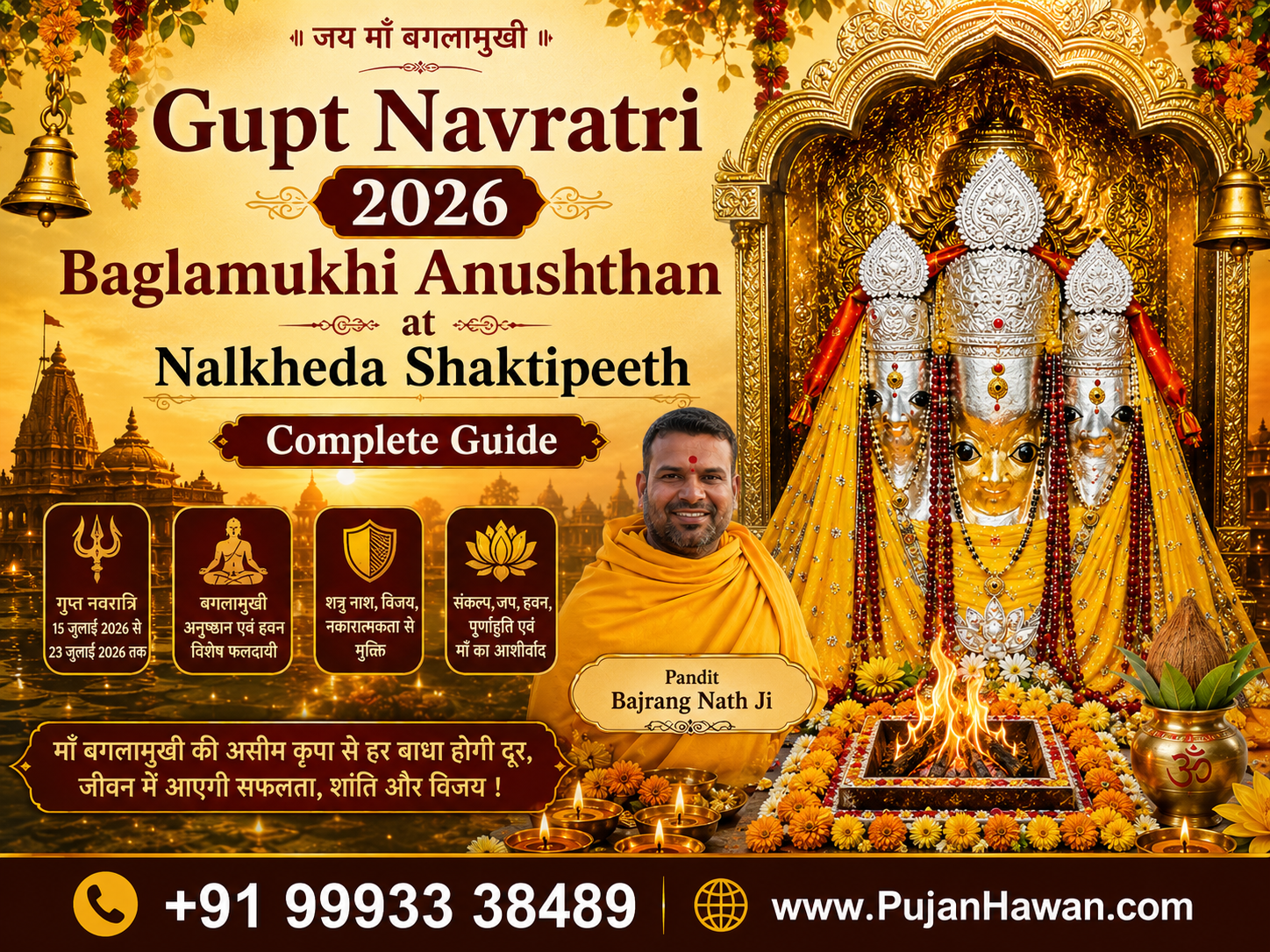
In 2026, the Ashadha Gupt Navratri falls from 15 July to 23 July, and at Nalkheda Baglamukhi Shaktipeeth, this window is treated with particular seriousness.
Why Gupt Navratri Is Different
The word "Gupt" means hidden or secret. Unlike the public Navratris, these nine days aren't marked by festivities – they're marked by intensity. Traditionally, this is when Tantric practitioners take up Sadhanas that are otherwise avoided during the rest of the year: rituals aimed at the Dus Mahavidyas, of which Maa Baglamukhi is the eighth.
The belief is straightforward – during Gupt Navratri, the veil between ordinary effort and extraordinary result is thinner. A ritual performed during these nine days is considered to carry more weight than the same ritual performed on any regular day.
That's precisely why devotees dealing with long-pending court cases, stalled businesses, hidden rivals, or unexplained misfortune specifically wait for this period to approach Pandit Bajrang Nath Ji at Nalkheda.
During Gupt Navratri, spiritual practices are believed to carry enhanced significance due to the concentrated nature of the nine-day period.
What Happens During the 9 Days at Nalkheda
At Nalkheda, the nine days aren't treated as one single event – they're built as a steady, cumulative process:
🔸 Day 1 – Sankalp
Your name, gotra, and the exact nature of your problem are recorded, and a formal intention is set before the deity.
🔸 Days 2–8 – Continuous Anushthan
Depending on the severity of the issue, Pandit Ji performs disciplined mantra jaap – sometimes reaching the 36,000 or 1.25 lakh count – along with daily Hawan using yellow samagri, turmeric, and pure ghee.
🔸 Day 9 – Poornahuti (Final Offering)
The Anushthan concludes with a final Hawan, sealing the ritual's intent.
Every day of the process is oriented around one thing: your specific Sankalp, not a generic prayer performed on your behalf.
Who Should Consider This Period
Gupt Navratri Anushthan is generally sought out by devotees facing:
Court Cases
Court cases or legal disputes that have dragged on without resolution.
Business Issues
Business stagnation, blocked payments, or sudden unexplained losses.
🛡 Protection
Suspected black magic, hidden enemies, or a persistent run of bad luck.
Rivalries
Political or professional rivalries requiring a stronger, more focused remedy.
If your situation has already resisted ordinary effort – legal advice, financial planning, conversations – Gupt Navratri is traditionally seen as the right time to add a spiritual layer to your approach.
Can You Join From Abroad?
Yes. A large number of devotees who book their Gupt Navratri Anushthan at Nalkheda are not physically present at the temple.
Pandit Bajrang Nath Ji takes the Sankalp over a phone or video call, using your name and gotra exactly as he would in person, and performs the ritual live at Nalkheda on your behalf.
You're welcome to join the live video call for as many days as you'd like, and a recording is shared for the days you can't attend live – useful for devotees across different time zones.
How to Book Your Gupt Navratri Slot
Given the fixed nine-day window (15–23 July 2026), slots are limited by nature – there's only one Gupt Navratri in this cycle, and the Anushthan needs daily continuity once it begins.
- Call or WhatsApp Pandit Bajrang Nath Ji to briefly share your situation.
- Pandit Ji will advise whether a 36,000 or 1.25 Lakh Anushthan fits your case.
- Your Sankalp is fixed, and you'll receive a schedule for daily updates or live video access.
FAQ
When is Gupt Navratri 2026?
The Ashadha Gupt Navratri in 2026 runs from 15 July to 23 July.
What makes Gupt Navratri different from regular Navratri?
Gupt Navratri is observed quietly, without public celebration, and is traditionally associated with focused Tantric sadhana rather than festive worship.
Can I do the Anushthan without visiting Nalkheda?
Yes. Pandit Bajrang Nath Ji conducts the Sankalp and ritual on your behalf via phone/video call for devotees who cannot travel.
How many days does the ritual take?
The full Gupt Navratri Anushthan spans all nine days, concluding with a Poornahuti (final Hawan) on the last day.
Gupt Navratri isn't about a single dramatic ritual – its strength comes from nine consistent days, each one building on the last. If there's a problem you've been carrying for a while, this window at Nalkheda is one of the more traditionally significant times to address it directly, whether you can be there in person or connect from anywhere else in the world.
Ready to book your Gupt Navratri Anushthan?
Recent Posts